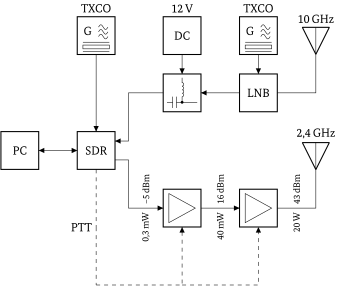
Die Gesamtverstärkung des Sendezweigs ergibt sich aus der Differenz zwischen Ausgangs- und Eingangsleistung in dBm.
Am Eingang des Verstärkerzweigs liegen
$$P_\mathrm{in}=\qty{-5}{\decibelmilliwatt}$$an, am Ausgang
$P_\mathrm{out}=\qty{43}{\decibelmilliwatt}$.
Damit beträgt die Gesamtverstärkung:
$$G=P_\mathrm{out}-P_\mathrm{in}=\qty{43}{\decibelmilliwatt}-\left(\qty{-5}{\decibelmilliwatt}\right)=\qty{48}{\decibel}$$Die Gesamtverstärkung des Sendezweigs beträgt somit $\qty{48}{\decibel}$.